
Getting Mesa County Court Records
The Mesa County Combined Court runs both trial-court tiers from the Justice Center. Its clerk holds District Court files. Those cover felony, major civil, domestic-relations, probate, juvenile, and water matters. County Court files live in the same office. They include misdemeanors, state traffic, small claims, evictions, and limited civil cases. Anything from a city code or municipal traffic case stays with that municipal court.
Match the channel to the item you want. The free Judicial Branch docket search shows settings. For a paid, real-time register of actions, CoCourts works. It does not carry filed images, though. Documents themselves can be requested through the state web form, by email at MesaRecords@judicial.state.co.us, by phone at 970-257-3640, at the Combined Court counter, or by mail to 125 N. Spruce Street, P.O. Box 20,000-5030, Grand Junction, CO 81501.
- Identify the court, case class, parties, year, and case number when known.
- Decide whether the needed item is a hearing entry, register of actions, pleading, order, decree, or certified copy.
- Choose the online form, records email, phone, clerk counter, or mail route.
- State each document clearly and request certification only when an authenticated copy is needed.
- Review the fee notice, pay the approved charge, and receive the record by the offered delivery method.
Mesa County Record Request Form
The Judicial Branch record and document form wants your contact details, Mesa as the county, and enough case data to pull the file. A case number works best. Party names can carry a search too. Name the document. That could be a decree, disposition and sentence order, protection order, civil judgment, satisfaction, probate paper, or register of actions. A certification choice tells the clerk whether you need an authenticated copy.
| Request Field | Requirement | Mesa Record Note |
|---|---|---|
| First, middle, and last name | First and last expected | Identifies the requester, not the case party |
| Business name | Optional | For a requesting business or office |
| Email and phone | Contact expected in practice | Used for delivery, questions, and the fee notice |
| Mailing address, city, state, ZIP | Required; second address line optional | Supports mailed certified research |
| County | Required dropdown | Choose Mesa |
| Case number | Optional if using a name search | Example format 2023AA123456 |
| Party names | Optional | Helps locate the correct court case |
| Documents requested | Required | Name each decree, order, register, judgment, or other item |
| Certification | Optional | Specify the document that needs authentication |
| Delivery or pickup | Choice not fixed | Certified research is sent by mail under the PDF instructions |
| Government identification | Conditional | May apply to suppressed, juvenile, probate, or protected records |
The Mesa-specific request route is shown on the official Mesa County records endpoint.
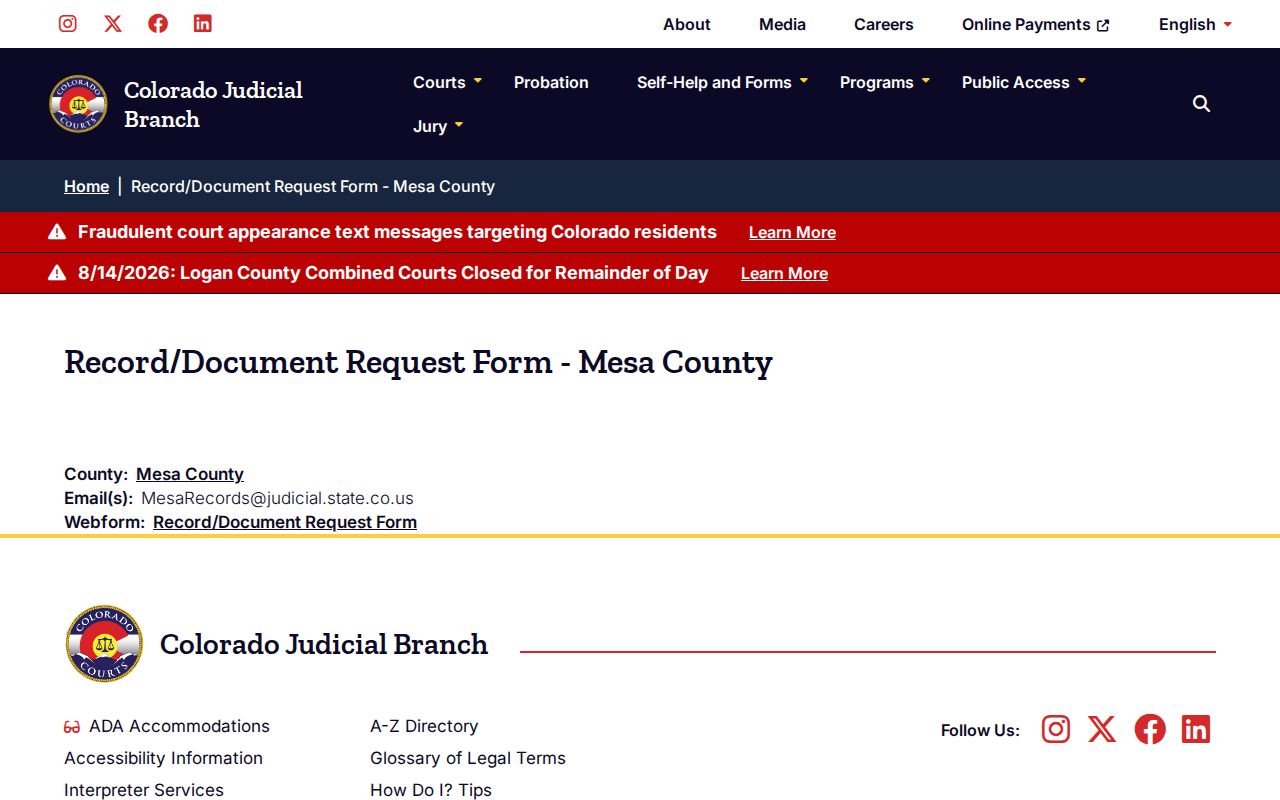
That form routes requests to the court record custodian through MesaRecords@judicial.state.co.us, not through a county executive office. The clerk generally answers with a response or estimate within three business days, unless unusual circumstances require more time. Expect to show government photo identification for suppressed, juvenile, probate, or other protected requests.
Court Record Types
Mesa County court records sit in three practical layers. The free docket lists scheduled hearings. The paid register of actions gives a chronological case summary: events, filings, settings, minute orders, and outcomes that are public. The case file holds the actual pleadings, orders, judgments, decrees, and other documents. A search result, in other words, never substitutes for the filed record.
Common requests include:
- a register of actions showing the public case chronology;
- complaints, petitions, answers, motions, and returns of service;
- orders, judgments, decrees, protection orders, and probate documents;
- criminal disposition and sentence orders or civil satisfaction records;
- plain, certified, or exemplified copies of a named court document.
CoCourts does not supply document images. The clerk does. If you first need the number or caption, the Mesa County case lookup can get you there before you place a document request.
Mesa County Court Record Layers
In Colorado, "docket" means the public hearing list. "Register of actions" means the event history. That vocabulary matters in Mesa County. Ask for a docket and you may get dates and courtrooms. Ask for the register of actions and you seek the case chronology. Ask for an order, decree, or pleading and you reach the document layer. The official access guide warns that vendor data is informational. It may omit a case or type, and it is not the certified court record.
A Mesa County register can show the court and division, party roles, attorney information, filing and service events, settings, minute orders, rulings, disposition, sentence, judgment, or post-judgment enforcement. Colorado Courts E-Filing, or CCE, serves authorized filers statewide. Public register access runs through an approved vendor, not the CCE filing interface. A District Court appeal entry may lead to the Colorado Court of Appeals. But the Combined Court remains the source for the Mesa trial-court file.
- Docket
- The Judicial Branch list of scheduled hearings and settings.
- Register of actions
- The dated sequence of public case events and court entries.
- Certified copy
- A clerk-authenticated copy used when formal proof is required.
- Disposition
- The result that resolves a charge or claim.
Inside a Mesa County Court Record
Contents vary by case. A Mesa County court record commonly opens with the year, class, sequence, court, division, caption, and status. Those fields sit at the top of the file. Civil files use plaintiff and defendant, or petitioner and respondent roles. Criminal files add charges, statute references, and sentence or disposition entries. Both can hold motions, notices, settings, minute orders, and signed rulings. Restricted exhibits or personal identifiers may be withheld or redacted.
| Case number | Year, class, and sequence, such as 2026CR528. |
|---|---|
| Parties and counsel | Caption names, legal roles, and attorneys shown in the public file. |
| Pleadings | Complaint, petition, answer, motion, response, summons, and proof of service when public. |
| Orders and judgments | Signed rulings, decrees, sentences, civil judgments, and later satisfaction or enforcement papers. |
| Register of actions | The dated index of filings, settings, minute orders, rulings, and disposition. |
| Exhibits | Filed material that may be public, redacted, protected, restricted, or sealed. |
A calendar card is much narrower. It lists date, start time, duration, caption, case number, hearing type, location, appearance type when filled, and courtroom. The full case history is not there.
Mesa County Offsite Court Files
An older Mesa County court file may not appear in a current online result. The gap can reflect a date range, name variation, municipal venue, restricted case type, or incomplete vendor coverage. It does not prove the case never existed. Ask the originating clerk before drawing a conclusion. The clerk can check the case number, approximate year, parties, and class.
Offsite retrieval is billed at actual cost. Research and redaction time can also apply. The official form lets the clerk send a notice before payment. That helps when the file is old or broad. A narrow request for a named order or register of actions is easier to price than a request for "everything." Certified research is mailed under the PDF instructions, while other research may arrive by email.
Note: When no case number exists, a party name, approximate year, case type, and known aliases can still help.
Fees and Certified Copies
Which copy do you need? That depends on what the asking office wants. A plain copy works fine for reading and reference. It suits your own Mesa County court docket research. A certified or exemplified copy carries the clerk's authentication, and another court or agency may require that formal proof before it accepts the filing. Charges vary by channel, and the live statewide court-record form lists the current amounts for each one. Paper and counter schedules can differ. So lean on the clerk's most recent notice for the route you pick.
| Item | Displayed Charge |
|---|---|
| Copies | $0.25 per page; party or party-lawyer copy requests have a $15 maximum, while nonparty requests have no maximum |
| Certified or exemplified document | $20 per document |
| Name search | $5 |
| Transcript of judgment | $25 |
| Certificate of satisfaction | $20 |
| Research or redaction | $30 per hour in 15-minute increments after the first hour |
| Offsite retrieval | Actual cost |
Clerk of Court, Mesa County Combined Court
125 N. Spruce Street, P.O. Box 20,000-5030
Grand Junction, CO 81501
970-257-3640
Mesa County Transcript Requests
Mesa County treats the spoken record of a hearing under its own rule. Administrative Order 15-03 says the district has no court reporters. It does not routinely release digital recordings or grant listening requests. A party who wants the record must instead request a transcript. Chief Justice Directive 05-03 governs that. A digital recording comes out only in extraordinary circumstances, at the judicial officer's discretion. It may carry a charge.
Keep this channel separate from the Combined Court clerk's case-document requests. The clerk handles pleadings, orders, the register of actions, and certified copies. A transcript is different. It is a written account of what was said in court. Name the hearing date, case number, division, and portion you need so the request lands in the right place. Exhibits sit apart again and may carry their own access limits.
Sealed Records and Public Access
Colorado court rules control public access to Mesa County court records. The county's general open-records process does not. The main rule is Chief Justice Directive 05-01. It covers inspection, remote access, exclusions, and compiled access. Remote access runs narrower than a visit to the counter. Juvenile, adoption, protected family, probate, sealed, suppressed, and restricted material may be unavailable online. Some items require identification and proof of authority. The directive page spells out each of these limits.
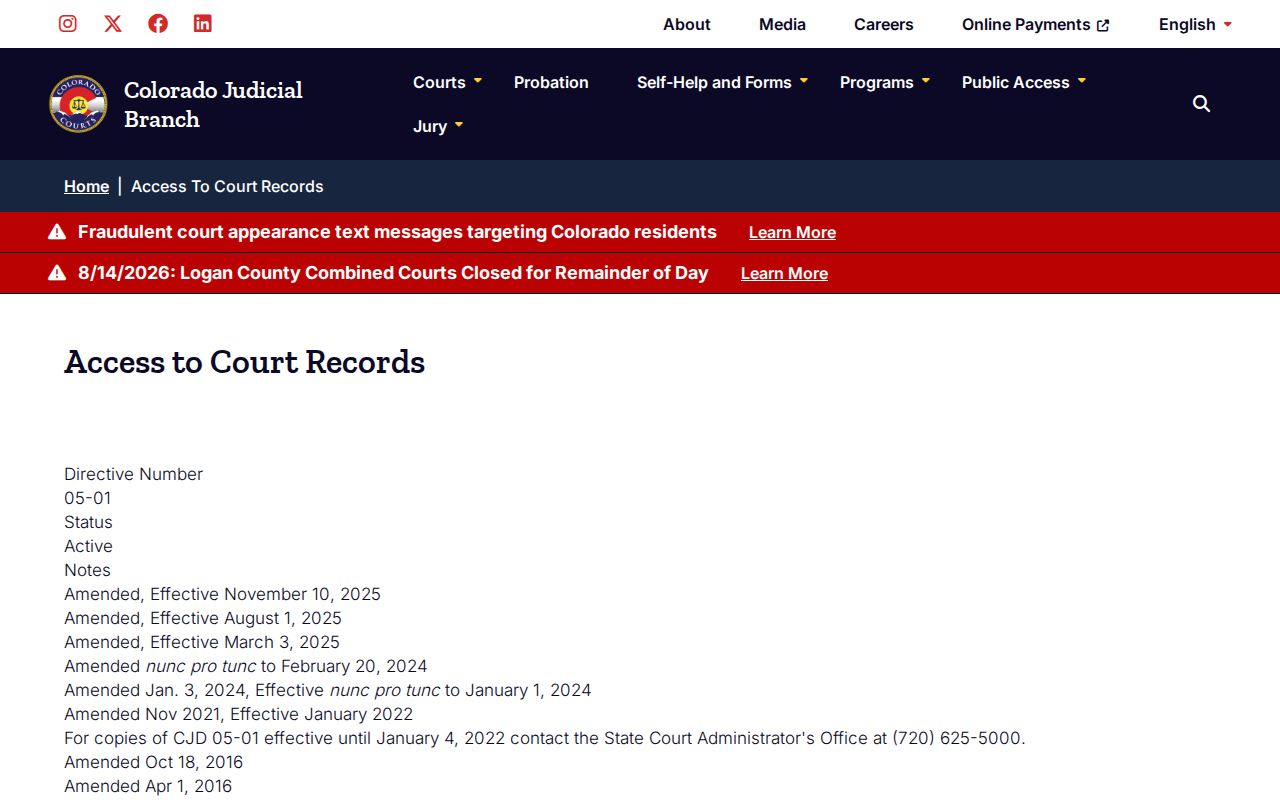
That official page sets the rule that governs judicial case access across the state. One limit deserves emphasis: an online case shell does not make every document inside it public.
Colorado access rules:
CJD 05-01 controls access to case court records and permits limits on remote viewing.
C.R.S. § 19-1-301 and following sections impose special limits on juvenile records.
CJD 06-01 governs court-record copy, retrieval, research, redaction, and scanning costs.
Mesa County Court Record Custodians
The elected Mesa County Clerk and Recorder keeps land, recording, election, and motor-vehicle records. Court case files are not among them. That office holds no District Court or County Court files at all. The Mesa County CORA guidance points divorce and criminal case requests away from county government. It sends them to the Justice Center. That is where the judicial records actually sit.
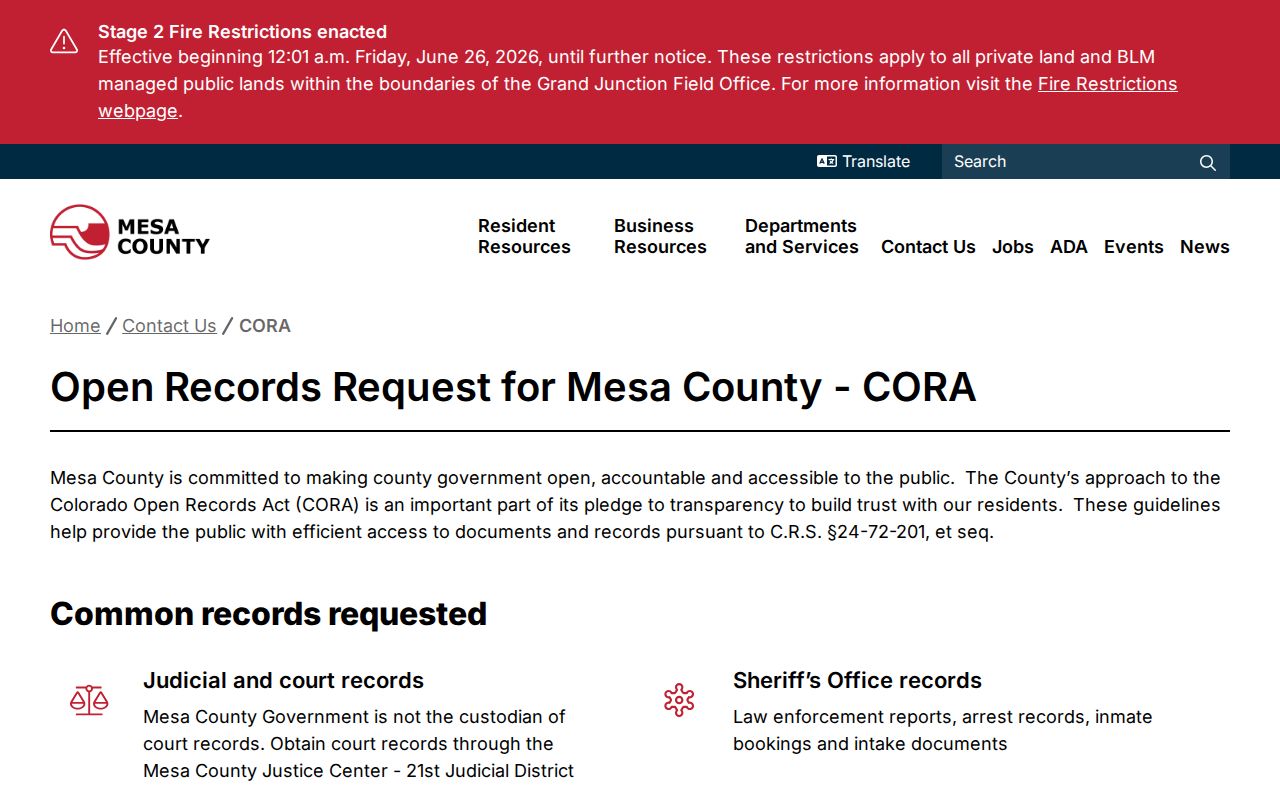
Treat the county guide as a routing warning. The Combined Court clerk is the right office for state judicial case records. Municipal clerks hold city-code matters, and the court's transcription channels handle hearing transcripts. Sheriff reports and prosecutor files stay with those agencies.
Knowing the split prevents a common delay. A CORA request sent to county government does not become a court-file request. Naming a case does not change that. Send the judicial request through the record form, MesaRecords email, telephone line, counter, or mail. If a public item seems missing, ask the court that created it. Access may be restricted. Or a more exact docket search might help.